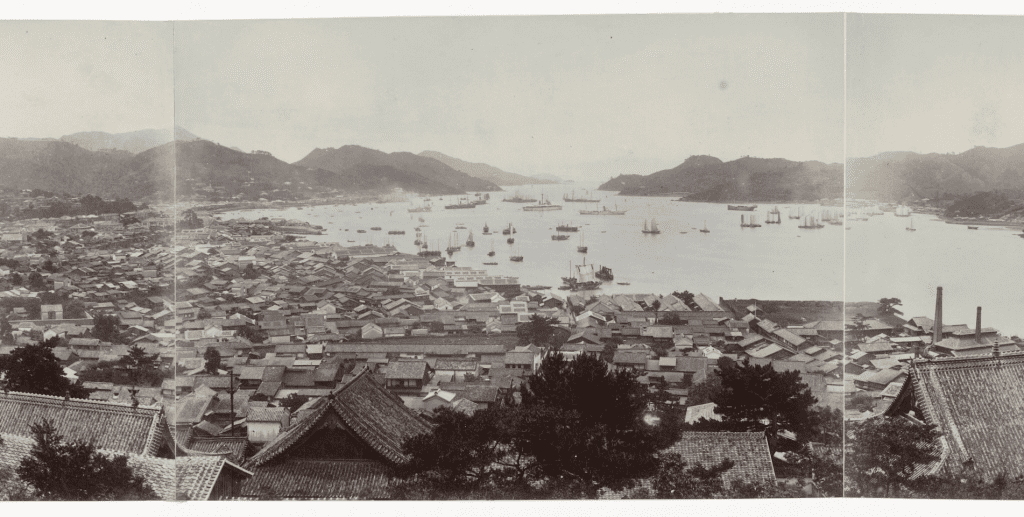
For over two centuries, Nagasaki was the only place in Japan where Europeans could legally trade. The fan-shaped island of Dejima—120 by 75 meters—contained the entire Western presence in the country. Dutch merchants lived under constant surveillance, their movements restricted, their trade regulated, yet through this narrow aperture flowed the knowledge that would transform Japan.
The Chinese quarter was larger but equally controlled. Thousands of traders from Fujian, Guangdong, and Zhejiang passed through Nagasaki, connecting Japan to the vast commercial networks of the South China Sea. The system wasn't isolation—it was managed access, calibrated to maximize benefit while minimizing foreign influence.
At Your Table
Shippoku ryōri is Nagasaki's signature cuisine—a fusion that could only have developed here, at the intersection of Japanese, Chinese, Dutch, and Portuguese traditions. Served at a round table (itself a Chinese introduction), the meal progresses through courses that might include pig's feet prepared in the Chinese style, fish cooked with techniques learned from Portuguese missionaries, and vegetables prepared according to Japanese sensibilities. The form preserves the cosmopolitan history of a city where cultures mixed despite official restrictions.
Castella—the sponge cake that has become one of Japan's most beloved sweets—arrived with Portuguese missionaries in the sixteenth century. The name derives from Pão de Castela, "bread from Castile," though the Japanese version evolved into something quite distinct: denser, moister, with the characteristic brown sugar bottom that marks the authentic Nagasaki product. The cake's survival through centuries of anti-Christian persecution testifies to how thoroughly certain foreign influences became domesticated.
The Chinese community's culinary legacy endures in champon and sara udon—noodle dishes that developed in Nagasaki's Chinese restaurants for a local clientele. Champon's rich pork broth laden with seafood and vegetables, and sara udon's crispy noodle base, are neither authentically Chinese nor traditionally Japanese, but something distinctly Nagasaki—evidence that even controlled contact produces creative transformation.
Cultural Encounters
Dejima has been reconstructed on its original site, offering a glimpse of the cramped conditions under which Dutch merchants conducted Japan's only European trade. The warehouses, the chief factor's residence, the garden designed to provide some relief from confinement—all can be explored today. Walking the perimeter of what was once an artificial island (now absorbed into the city's reclaimed waterfront), you trace the boundary between the Tokugawa order and the world beyond.
The Tōjin Yashiki—the Chinese residence compound—was larger and more permeable than Dejima, home to thousands of traders during the peak trading season. The Confucian shrine (Kōshi-byō) at its center remains the only Confucian temple in Japan built by and for Chinese residents, its architecture distinctly different from the syncretic temples found elsewhere in Japan. The compound's remains sketch the outline of a community that, while controlled, maintained its cultural identity across generations.
Nagasaki's Hidden Christian sites tell a parallel story of cultural contact and its consequences. The faith brought by Portuguese missionaries survived two and a half centuries of prohibition, preserved in secret by communities who disguised Christian prayers as Buddhist chants and hid sacred objects in their homes. When Japan reopened in the 1850s, the missionaries who returned found descendants of sixteenth-century converts still practicing their faith—transformed by isolation into something neither quite Catholic nor entirely Japanese.
A Note from Your Expert
Nagasaki was Japan's most cosmopolitan city for over two centuries—long before that term existed. The merchants, interpreters, and officials who worked here developed a sophistication about foreign cultures that had no parallel elsewhere in Japan. That worldliness persists: there's an openness to Nagasaki, a comfort with difference, that sets it apart from more homogeneous cities. The fusion cuisines and hybrid architectures aren't tourist attractions—they're the natural expression of a place that has always lived at the boundary between Japan and the wider world.