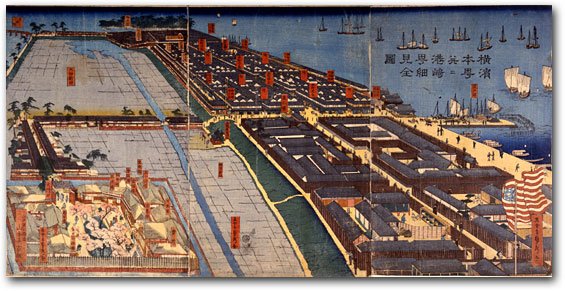
Our voyage ends where Japan's modern transformation began. In 1868, the Meiji Emperor moved from Kyoto to Edo, renaming it Tokyo—the "Eastern Capital." The Shogun's castle became the Imperial Palace. Samurai mansions gave way to government ministries, railway stations, and modern commercial districts. The city that had been the seat of warrior government became the capital of a modernizing nation-state.
Arriving by sea, we approach Tokyo as travelers have for centuries—through the bay that guarded the Shogun's capital, past the fortifications that once controlled access to the city. The view has changed beyond recognition: where fishing villages once lined the shore, now container ports and urban sprawl extend to the horizon. Yet the journey itself connects us to all who came before on these waters.
At Your Table
Arriving in Tokyo after tracing the maritime routes that connected the Ryukyu Kingdom to the Shogun's capital, the city's food culture takes on new dimensions. The fish markets that have fed Tokyo since the Tokugawa period—now relocated from Tsukiji to Toyosu—represent the endpoint of supply chains that once stretched to the southern islands. The regional cuisines that converge here traveled routes we have just sailed.
Edo's restaurant culture emerged to serve the enormous population of samurai required to maintain residences in the Shogun's capital. Far from home, these warriors and their retainers needed to eat, and the establishments that served them developed into one of the world's first sophisticated dining scenes. The descendants of those restaurants—some claiming continuous operation for centuries—preserve traditions that were already old when the city changed its name.
Cultural Encounters
Tokyo is often described as a city without history—rebuilt after earthquakes and firebombing, constantly demolishing and reconstructing. But our voyage has revealed a different perspective. The city's centrality, its role as the terminus of trade routes and administrative networks, its position as the place where regional products were consumed and redistributed—all this persists beneath the contemporary surface. The geography that made Edo the Shogun's capital continues to organize Tokyo today.
A Note from Your Expert
Our voyage from Hong Kong to Tokyo has traced routes that were ancient when the cosmopolitan ports were established and that persist, in transformed form, today. We have seen how islands mediated between empires, how trade created cultures, how commerce and craft produced cuisines that outlived the systems that created them. Arriving in Tokyo, you see the city differently than you would have before: not as an endpoint but as a node in networks that extended across the East Asian seas, not as purely Japanese but as the terminus of connections that reached to China, Korea, and Southeast Asia. The Shogun's capital was never isolated; it was the center of a maritime world that our voyage has traced.
Begin from Tokyo?
The Tokyo → Hong Kong voyage departs for Hong Kong, tracing the cosmopolitan port world from the Shogun's capital through Korea to China—the route of merchants, envoys, and empires.
Explore Tokyo → Hong Kong