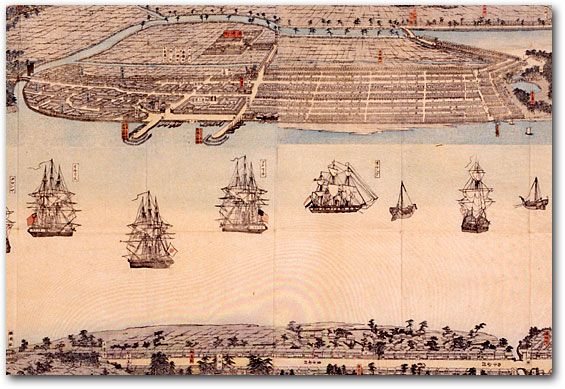
We begin where the old regime ended. Tokyo was Edo until 1868—the seat of Tokugawa power, a city built around a castle, organized by status, and fed by tribute from every corner of Japan. When the Meiji Emperor moved here from Kyoto, the name changed but the centrality remained. Tokyo is still where Japan is governed, and our voyage starts at the center before moving to the edges.
At Your Table
Edo's food culture was born from political circumstance. The sankin-kōtai system—which required domain lords to maintain residences in the capital and travel there in alternate years—created an enormous floating population of samurai, servants, and hangers-on, all far from home and needing to eat. The result was one of the world's first restaurant cultures: thousands of establishments serving every regional cuisine, from Kyoto refinement to Osaka heartiness to the seafood traditions of every coastal domain.
The fish markets that supplied Edo traced their origins to the sixteenth century, when fishermen were granted the privilege of selling their catch at Nihonbashi. What began as a simple exchange grew into the vast wholesale network that would eventually become Tsukiji, and now Toyosu. The system of seasonal awareness (shun) that governs Japanese cuisine—knowing precisely when each fish, vegetable, or fruit reaches its peak—developed here in dialogue between discerning customers and competitive vendors.
Tokyo remains a city where regional foods converge. The soba noodles of Shinano, the pickles of Kyoto, the beef of Kobe—all found their way to the Shogun's table and then to the restaurants that served his retainers. Today's Tokyo cuisine is less a single tradition than a curated collection of the best Japan has to offer, refined by centuries of demanding patrons.
Cultural Encounters
Modern Tokyo has consumed most of Edo, but fragments remain for those who know where to look. The Yanaka district, spared both the 1923 earthquake and the 1945 firebombing, preserves the narrow lanes and temple precincts of the old city. Nihonbashi—the "Japan Bridge" from which all distances in the realm were measured—still stands at the point where the great highways departed for the provinces, though an expressway now shadows the historic crossing.
The transition from Edo to Tokyo was remarkably swift: within a generation, the Shogun's castle became the Imperial Palace, samurai mansions gave way to government ministries, and the city's orientation shifted from the castle to the railway stations that would define modern urban life. Yet the structure persists beneath the surface—the moats that once protected the Shogun now ring the Emperor's gardens, and the old domain lord residences have left their names on neighborhoods throughout the city.
Tokyo's craft traditions link directly to Tokugawa patronage. The woodblock printing that developed here to serve Edo's appetite for illustrated books and actor prints continues in workshops that use techniques unchanged for centuries. Textiles, lacquerware, and metalwork that once served the warrior elite now find new audiences among collectors who appreciate the deep history embedded in each object.
A Note from Your Expert
First-time visitors to Tokyo often divide the city into "modern" and "traditional"—Shinjuku versus Asakusa, skyscrapers versus temples. I find it more useful to see Tokyo as layered: the Edo period beneath the Meiji, the Meiji beneath the postwar, all coexisting in ways that only become visible when you know what to look for. A shrine tucked between office buildings isn't an anachronism—it marks a sacred space that survived because it was too important to remove, while everything around it transformed.