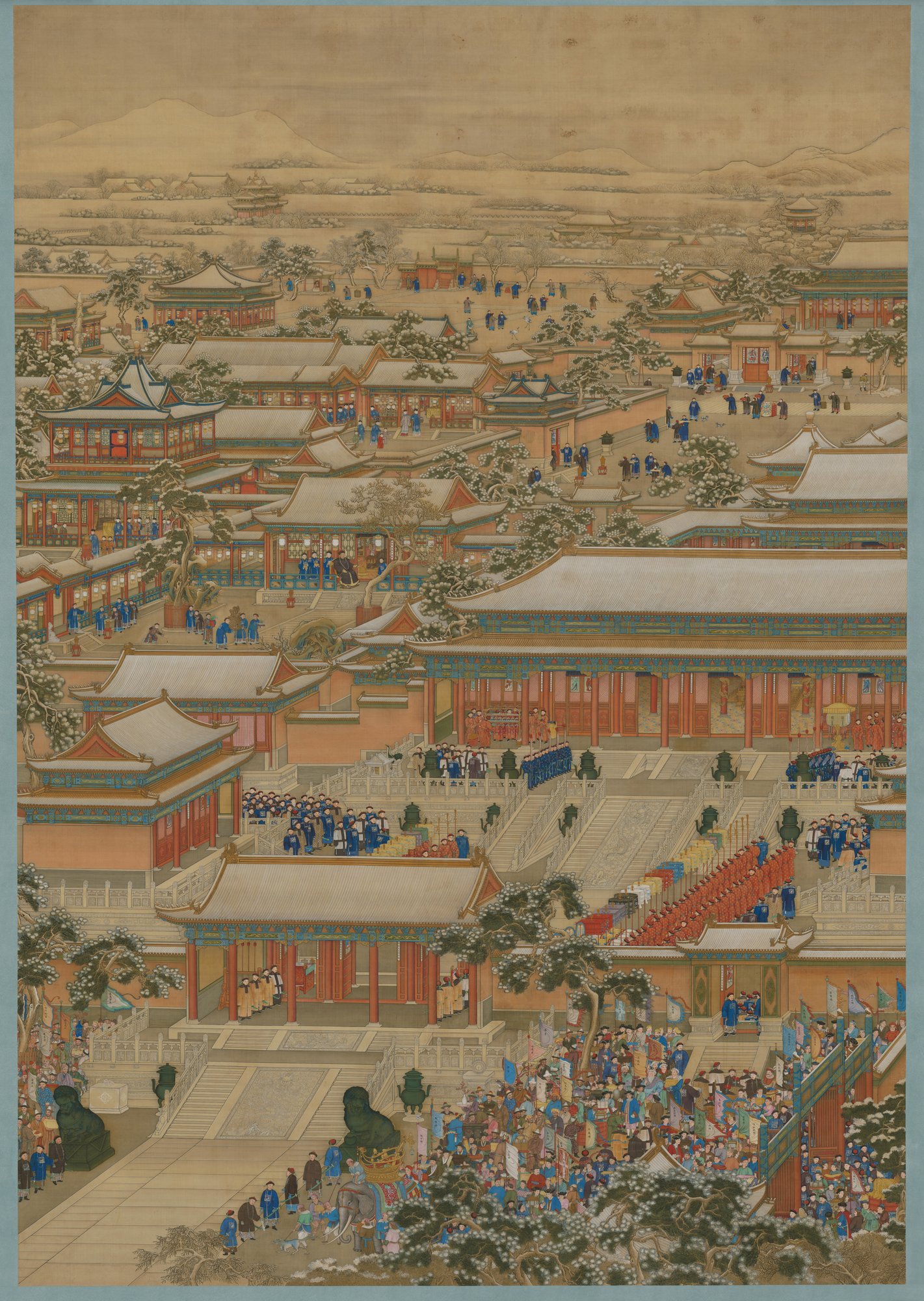
The Logic of Tribute
The tributary system (chaogong) was built on a cosmological premise: the Chinese emperor ruled "All Under Heaven" (tianxia) by virtue of the Mandate of Heaven. He was not merely a powerful king among kings but the pivot connecting heaven and earth, the source of civilizing influence that radiated outward to the world. Foreign rulers who acknowledged this cosmic order—by sending tribute missions, performing ritual obeisance, and accepting investiture from the emperor—became participants in Chinese civilization rather than mere outsiders.
This was not, from the Chinese perspective, a system of domination. It was a hierarchy of culture, not of conquest. Tributary states retained full internal sovereignty. China did not station troops on their soil, did not extract taxes from their populations, did not interfere in their domestic governance. What China demanded was ritual acknowledgment—and what it offered in return was substantial: legitimacy, access to Chinese markets, and membership in a civilized order that conferred prestige.
The Mechanics of the System
Tribute missions followed elaborate protocols. Envoys traveled to Beijing bearing specified goods—horses, sulfur, precious metals, local specialties—and formal documents acknowledging the emperor's supremacy. At the imperial court, they performed the kowtow: three kneelings and nine prostrations before the Dragon Throne. In return, they received imperial gifts often exceeding the value of their tribute, along with permits to conduct trade.
The trade component was crucial. Tributary missions were permitted to bring commercial goods beyond the formal tribute, selling them at designated markets. For smaller states like Ryukyu, this trade was enormously profitable—the real economic value of the relationship lay not in the symbolic exchange of tribute and gifts but in the commercial opportunities that accompanied it. States competed for the privilege of sending frequent missions precisely because each mission meant access to Chinese markets.
Different states held different positions within the system. Korea, as China's closest and most loyal tributary, sent annual missions and received special recognition. Ryukyu, despite its small size, maintained frequent contact and derived substantial commercial benefit. Vietnam, Siam, and Burma participated on their own terms. Even states that traded with China without formal tributary status—including, eventually, European powers—were understood by the Qing court as fitting somewhere within this hierarchical framework.
Investiture and Legitimacy
For tributary states, Chinese recognition conferred legitimacy that mattered both domestically and internationally. When a new king ascended the throne in Korea or Ryukyu, he requested investiture from the Chinese emperor. The emperor dispatched envoys (sappōshi in Japanese, chaekbongsa in Korean) who traveled to the tributary capital and performed elaborate ceremonies confirming the new ruler's authority.
These investiture missions were major events. In Ryukyu, Chinese envoys might remain for months, entertained with banquets, performances, and displays of local culture. The missions affirmed the tributary relationship, but they also provided opportunities for cultural exchange, diplomatic negotiation, and commercial dealing. They were, in effect, state visits—moments when the tributary relationship was performed, renewed, and given concrete expression.
The legitimacy that investiture conferred was real. A king who had received Chinese recognition could claim to rule with the sanction of the civilized order. His domestic rivals could not easily challenge his authority without also challenging the cosmic hierarchy that underwrote it. The tributary system, for all its ritual formality, served practical political purposes.
The Canton System
China managed Western maritime trade through a related but distinct mechanism: the Canton system. From 1757 to 1842, all Western trade was confined to the single port of Canton (Guangzhou), conducted through licensed Chinese merchants (cohong) who served as intermediaries. Foreign traders could reside in Canton only during the trading season, confined to a narrow strip of waterfront outside the city walls. They could not learn Chinese, could not communicate directly with Chinese officials, could not bring women or weapons into the trading zone.
The Canton system reflected the same logic as the tributary order: foreign contact was permitted but controlled, channeled through designated intermediaries, and subjected to Chinese regulation. The Qing court did not recognize European concepts of diplomatic equality or international law. To Chinese officials, the British East India Company was simply another group of tribute-bearing barbarians seeking access to Chinese goods—to be managed, not negotiated with as equals.
This mismatch of worldviews would prove explosive. When British diplomats sought direct communication with the emperor, they were rebuffed. When they demanded trade on terms of equality, they were informed that China had no need of foreign goods. The Opium War that followed was not merely a conflict over narcotics; it was a collision between incompatible systems of international order.
The System Under Pressure
The unequal treaties imposed after the Opium Wars did not immediately destroy the tributary system, but they fundamentally challenged its premises. The treaties established that foreign powers would deal with China as sovereign equals, not as tribute-bearers seeking imperial favor. They created extraterritorial enclaves where Chinese law did not apply. They fixed tariffs by international agreement rather than imperial decree.
The tributary relationships with Korea and Ryukyu persisted longer. Korea continued to send missions to Beijing into the 1890s, even as it signed treaties with Japan and Western powers. Ryukyu maintained its tribute relationship until Japan formally annexed the kingdom in 1879. But the logic of the system was eroding. When Japan treated Korea as a sovereign state in the Treaty of Kanghwa, it implicitly rejected Chinese claims to suzerainty. When Japan annexed Ryukyu, it demonstrated that military power trumped ritual legitimacy.
The Sino-Japanese War of 1894–1895 ended the tributary system in East Asia. China's defeat proved that it could no longer protect its tributaries or maintain its position at the center of regional order. The Treaty of Shimonoseki required China to recognize Korean independence—freeing Korea from the tributary relationship only to expose it to Japanese domination. A system that had structured East Asian relations for centuries gave way to the world of empires, nation-states, and international law that European powers had carried across the oceans.